Start with the document, not the percentage
A certificate of analysis, often shortened to COA, is a record of analytical findings. Its value comes from the connection between the named sample, the tests performed and the results. Read the full document, including attachments and notes, before interpreting a headline number.
The examples below come from reports already published in Aera’s lab-results archive. They are historical report examples, not a statement about current inventory or the lot in a particular order. The original laboratory and client names are retained. Ask Aera to confirm the applicable lot if you need documentation for supplied material.
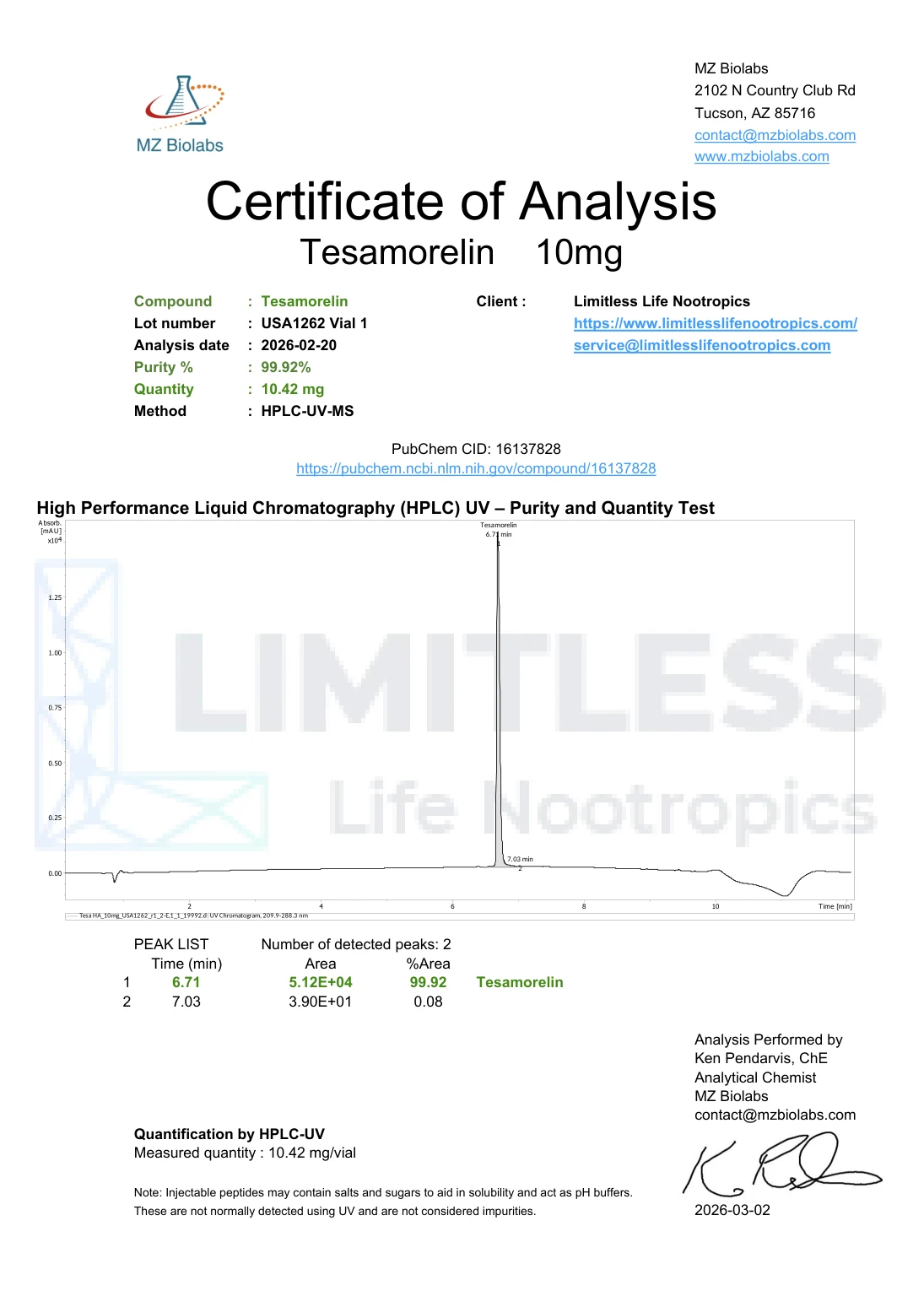
For this walkthrough, use the MZ Biolabs Tesamorelin report for USA1262 Vial 1. Page one contains the sample details, a chromatogram and quantity result. Page two contains the mass spectrometry identity result. Reading only the first page would miss part of the evidence.
Find the laboratory, sample and dates
| Field on the report | Recorded value | How to read it |
|---|---|---|
| Laboratory | MZ Biolabs | The laboratory named as performing the analysis. |
| Client | Limitless Life Nootropics | The client named on this report, not a replacement name added by Aera. |
| Lot number | USA1262 Vial 1 | Preserve the complete identifier, including the vial designation. |
| Analysis date | 20 February 2026 | The stated analysis date. |
| Date beside analyst signature | 2 March 2026 | A separate printed date; do not substitute it for the analysis date. |
| Method | HPLC-UV-MS | The reported analytical approach. |
Aera’s archive explains that selected US-fulfilled reports are issued in a laboratory partner’s name. That context does not remove the need to match the applicable lot. A report with a different client name needs an explained supply relationship, not a silently edited certificate.
Read purity, quantity and identity separately
| Question | Result in this example | Meaning |
|---|---|---|
| What is the reported purity? | 99.92% | The main peak accounts for 99.92% of the listed integrated UV peak area. |
| What quantity was measured? | 10.42 mg/vial | A separate HPLC-UV quantity result for the tested vial. |
| What mass was reported? | 5132.72 Da expected and measured | Page two reports matching monoisotopic mass values and the laboratory’s identity conclusion. |
The 10 mg in the report title is the nominal description. The measured quantity is 10.42 mg/vial. The 99.92% result is a different measurement again. Do not multiply the nominal 10 mg by the purity percentage and present the answer as the measured quantity.
See purity versus peptide content for the distinction, and HPLC and mass spectrometry for the methods.
Check the supporting chart and peak list
On page one, the main peak is listed at 6.71 minutes with 99.92% area. A second peak is listed at 7.03 minutes with 0.08% area. These entries explain where the reported area percentage comes from. Retention time is a result under the specific chromatographic conditions, not a universal fingerprint that must match every laboratory.
Notice what the report does not establish
This two-page report contains purity, quantity and mass-based identity findings. It does not present sterility or endotoxin results. That means those properties are not established by this document. It does not mean that no separate test could exist.
An analytical result also does not establish clinical safety, medical effectiveness or suitability for human use. Keep the report’s scope separate from broader claims about a material. A historical test is not evidence of its condition after an undocumented storage or shipping event.
Use a short reading checklist
- Read every page and attachment.
- Record the laboratory, client, sample or lot identifier and dates.
- Write down each result with its method and units.
- Check the chart or supporting table where provided.
- List the questions the report does not answer.
- Confirm which lot applies to the material you are evaluating.
The next step is verifying the report and its connection to a batch. Interpretation and provenance are different checks.
Common questions
Is a COA the same as a safety data sheet?
No. A COA records analytical results for an identified sample or lot. A safety data sheet addresses hazards and handling information. One does not replace the other.
Does 99% purity mean every quality test passed?
No. Interpret the purity result within its method. Identity, quantity and other attributes require their own evidence.
Can I use this example to identify my order’s lot?
No. Use the identifier on the supplied material and ask Aera to confirm the corresponding report. The report here is an educational example from the archive.
Sources and original reports
- MZ Biolabs: Tesamorelin, USA1262 Vial 1, pages 1 and 2
- Aera lab-results archive and partner-report context
Report examples checked against the public files on 14 October 2026. Laboratory authorship of a source report does not imply review or endorsement of this article.